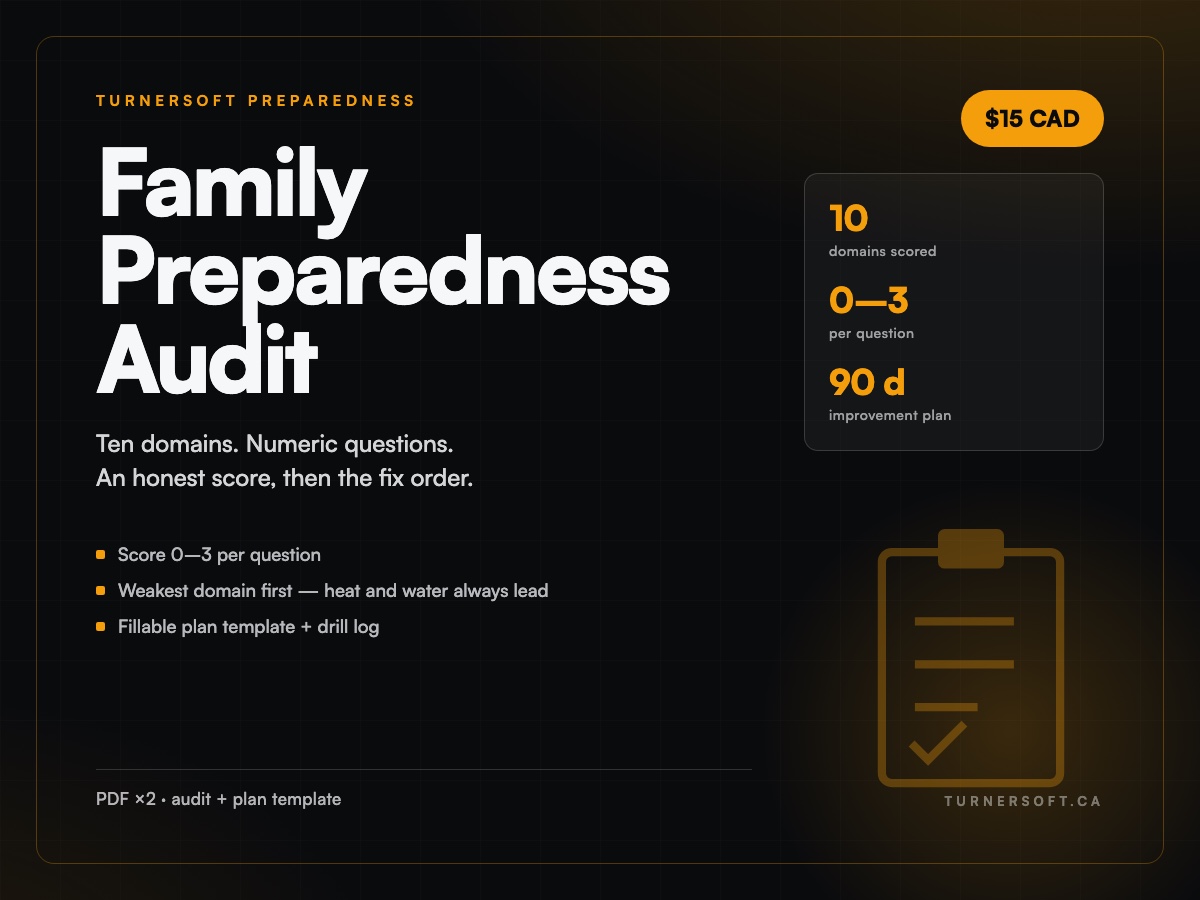
 Family Preparedness Audit + Plan Template · 2 PDFs, 34 pages · $15 CAD
Score the house you have before a storm scores it for you.
Seventy-five questions scored 0–3 across ten domains, with a total out of 225 and a band you can compare year over year. Then the second PDF turns the score into a written plan: owners, dates and a signed review page. The audit tells you where you are weak before it tells you what to buy.
What it is
Two PDFs that are meant to be printed and written on. The 20-page audit scores your household and hands you a work order. The 14-page plan template is the companion that turns those scores into a document the family can find in the dark.
Every question is numeric and verifiable — “Do you store ≥ 4 L per person per day for ≥ 7 days?” rather than “are you prepared?” — and each one carries a one-line note on what a good answer looks like.
The ten domains, and what each is worth
Original, not relabelled. Both PDFs are written from first principles for a Canadian household, with general public-domain doctrine as background and no third-party books reproduced or redistributed. There is no US federal framework in it, at any layer.
| Domain | Questions | Maximum points |
|---|---|---|
| 1 · Heat | 8 | 24 |
| 2 · Water | 8 | 24 |
| 3 · Food & Cooking | 8 | 24 |
| 4 · Sanitation | 7 | 21 |
| 5 · Power & Fuel | 8 | 24 |
| 6 · Medical & Medication Continuity | 7 | 21 |
| 7 · Communications | 7 | 21 |
| 8 · Security & Light Discipline | 7 | 21 |
| 9 · Documents & Money | 7 | 21 |
| 10 · Skills & Drills | 8 | 24 |
| Total | 75 | 225 |
The scale is a capability ladder, not a feeling
| Score | What it means |
|---|---|
| 0 · Absent | No capacity at all. |
| 1 · Improvised | Partly works, untested, unknown capacity, or it exists only in your head. |
| 2 · Stocked | The capacity physically exists, correctly sized and stored, but has not been used under pressure. |
| 3 · Stocked and drilled | The capacity exists and was exercised in the last 12 months, with a logged date and a measured result. |
The 3 tier requires a drill. That is the deliberate difference between a household that owns equipment and a household that can use it.
Your Preparedness Index is points earned divided by 225, as a percentage. The bands are plain: 0–25 critical, 26–50 fragile, 51–75 functional, 76–100 resilient. Each domain gets the same treatment against its own maximum, so you can see the shape of the problem and not just the total.
Five answers that override the score
A score of 0 on any of these is a this-week action, however good the Index looks:
- Freeze protection for your water system
- Seven days of stored water
- Two correctly placed carbon monoxide alarms
- A legal generator connection
- Fourteen days of every routine prescription
The remediation order respects physics. The audit derives a priority list from your own scores — weakest domain first — but heat and water always occupy the top two positions, because those are the two that kill in an Ontario winter. Any override item scored 0 jumps to the front of the list regardless of domain.
Then it becomes a written plan
The audit ends with a 90-day improvement plan in three 30-day blocks, a 30-day quick fix for a critical score, a 12-week progress tracker, three budget tiers in CAD ($250 core, $462 complete, $750, $2,500) and a “what not to buy first” table. The plan template is the second PDF, and it is where the work actually lives:
- Household roster, and a “who needs what” table that scales every stored quantity to a named person, with the quantity, the days and where it is kept
- Property profile, ranked risks, fuel and supply accounts, water and septic specifics
- The winter room and the heat-loss clock, with a cold-weather decision rule
- Emergency numbers, a written contact tree — who calls whom — and where everyone will be
- Medication continuity form with a cold-chain log, and the devices that need power
- Go/no-go evacuation page with 10 triggers, what leaves with you, vehicle and route readiness, and what to do if you are ordered to evacuate
- Drill log and drill menu, skills currency, and bleeding control in brief
- Supplies inventory — water, food, fuel and power, sanitation — with expiry and rotation columns
- Version control and an annual checklist, signed and dated, and re-dated every 90 days
The template’s own first instruction is the honest one: date everything, because a plan without dates is a rumour. Its second is to treat every blank as an action item.
Canadian references throughout
| Reference | Where it lands in the audit |
|---|---|
| Alert Ready | Canada’s national wireless public-alerting system: civil and Environment Canada alerts reach compatible phones with no app and no subscription. The audit treats it as the official Ontario channel, and notes it still needs a working carrier network — which is why the battery radio stays in the plan. |
| 211 Ontario | Community services and reception-centre information, alongside 511 for provincial highway conditions and 811 for health advice — all three named with the caveat that none of them works when the network is down. |
| TSSA and CSA B149.1 | Propane appliance siting, cylinder storage and transport are regulated by the TSSA under CSA B149.1. |
| CSA B365 and WETT | Solid-fuel appliances and chimneys are installed to CSA B365, and many insurers require a WETT-certified chimney inspection before they will cover wood heat at all. |
| CSA B415.1 | Wood-stove certification — the Canadian standard, not the US EPA label. |
| Free naloxone | A take-home naloxone kit is free in Ontario from participating pharmacies and public-health units, and the audit says so plainly. |
| Bleeding control | A short, explicit summary: press hard on the wound for 10 minutes without lifting the dressing, pack a deep wound, place a commercial tourniquet 5 – 8 cm above the wound and never over a joint, write the time on it and do not loosen it. |
| The pharmacist carve-out | An Ontario pharmacist can extend or renew an existing prescription and provide an emergency supply when the prescriber cannot be reached — commonly up to 30 days — but that authority excludes narcotics and controlled substances, and the prescriber must be notified. If a medication is a controlled substance, the audit says the plan changes and you need your prescriber in the loop before winter. |
What a question actually asks
Domain 5, Power & Fuel, question 4:
“Can you start the generator, connect it, and carry the critical loads in ≤ 15 minutes, in the dark, at −20 °C, and have you done it in the last 6 months?”
What a good answer looks like: a timed, logged attempt — including the choke, the priming, and the fact that cold fuel does not flow like warm fuel. That is the standard the whole domain is scored against: legal connection, correct sizing, 72 hours of fuel, and a cold start inside 15 minutes.
What it does not cover
The audit is an educational self-assessment tool, and it says so on its final page. It is not engineering, medical, electrical or legal advice, and it directs the reader to a licensed electrician, their prescriber and pharmacist, a licensed contractor, and their local public health unit.
Its reference figures are planning figures, labelled as such. Temperatures, fuel consumption, water quantities, freezer hold times and medication storage ranges are typical values, not guarantees for your house, appliance or well.
Its prices are estimates. The Part 5 prices are approximate Ontario retail in CAD, labelled for local verification — they exist to make a spending order concrete, not to act as a quote.
It is not a tactical or defence document, and it does not cover long-term collapse or off-grid living.
Family Preparedness Audit + Plan Template — $15 CAD
Two PDFs, US Letter: the 20-page scored audit and the 14-page fillable plan. Print them or type into them in any PDF editor. One household, unlimited personal printing, instant download.
The rest of the line
Winter Grid-Down Playbook — $27
Every domain the audit scores is answered at length in the playbook, in threat order, with the arithmetic.
Preparedness Calculator Pack — $39
The audit tells you which domain is weakest; the calculators size the water, food, fuel and wood that close the gap.
The Complete Preparedness Kit — $65
All three products, four files, $16 less than buying them separately ($81).