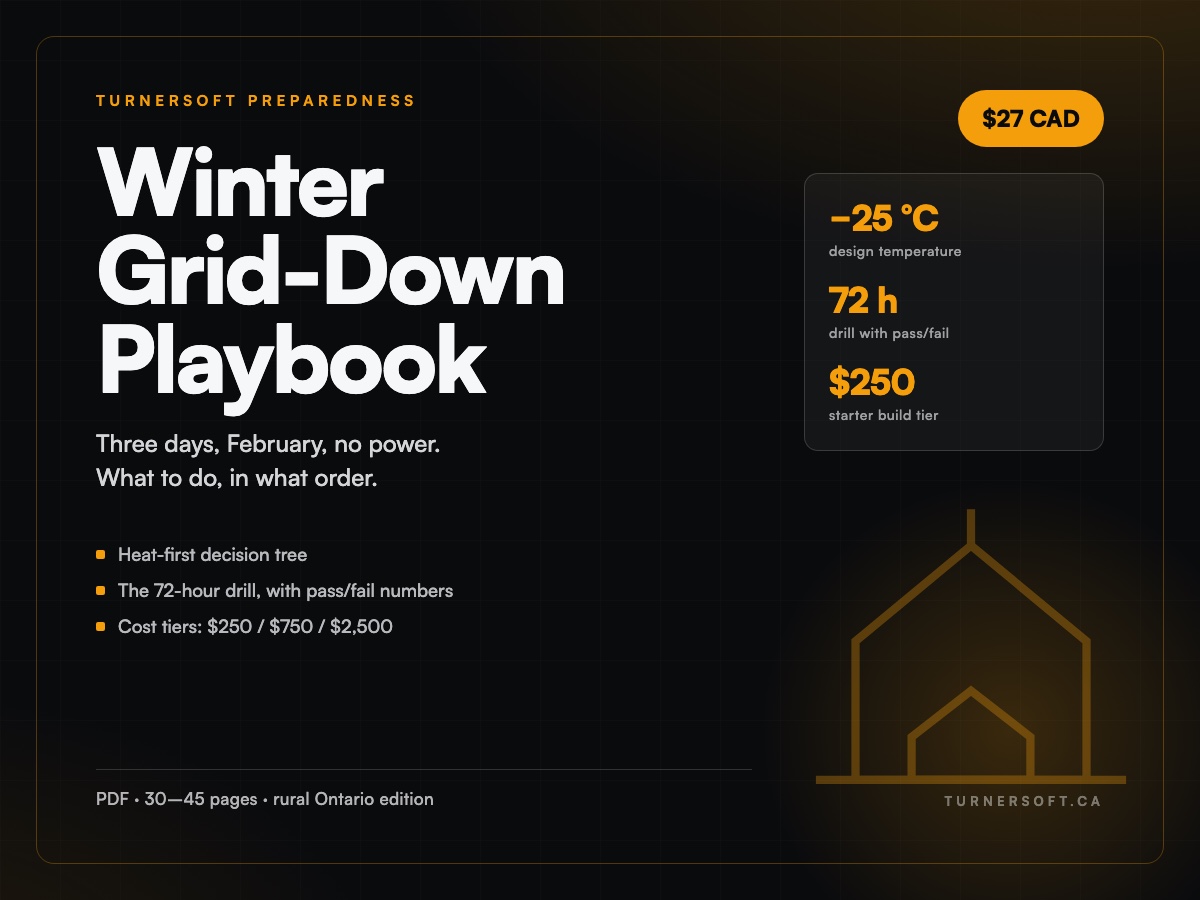
 Winter Grid-Down Playbook · PDF, 43 pages · $27 CAD
For the night the power does not come back on Tuesday.
An ice storm takes the grid down for three days in February. The house is at 9 °C, the well pump is dead, the road is closed and the generator is in the shed. This book is what you do, in what order, with the numbers — written for rural Ontario, not a Texan summer.
What it is
A 43-page PDF for the fifty to two hundred hours between the transformer arcing on the concession road and the crew arriving from the utility. It is a logistics problem with numbers attached, and it is built to be worked rather than read.
Threat order, not topic order. Alphabetical-by-subject preparedness puts candles next to can openers and tells you nothing about what actually kills people. This book is ordered by what takes you out first: heat, water, food, sanitation, power, medical, comms, security, recovery. If you read one chapter, read Heat First.
Every chapter has the same four parts: the problem and the physics behind it, the numbers (volumes, watts, litres, dollars, hours), the build (what to buy and do, in order), and a drill — a pass/fail test you run before you need it.
What is inside
Written from scratch, for here. Every word is original: no copied chapters, no relabelled American product, and no US federal doctrine reproduced. The copyrighted books on the shelf behind this work are never quoted or redistributed. Metric throughout, with Imperial in brackets only where a reader meets one on a label.
| Chapter | What it covers | The drill it ends with |
|---|---|---|
| 1 · Heat First | Why cold outranks everything, heat sources ranked by grid dependence, what heat costs to run, the codes that come with the fuel, and the carbon-monoxide rule with no exceptions | One night on one room |
| 2 · Water | The well is not the problem, the pump is. Storage and rotation, treating water you are unsure about, what boiling costs in fuel, getting water out of a well with no power, frozen plumbing | 48 hours of water with no tap |
| 3 · Food | Calories rather than comfort, what to eat first, cooking with no power, fridge and freezer salvage after the outage starts | Cook three days of food with no grid power |
| 4 · Sanitation | The failure everybody underestimates: the toilet, greywater and hygiene, garbage over a two-week outage | 72 hours of full sanitation with no running water |
| 5 · Power | Watts against watt-hours, generator sizing against your real loads, the one legal way to connect, fuel that keeps and for how long, batteries and inverters in the cold | Run the house on backup power for 24 hours |
| 6 · Medical | Medication continuity, hypothermia and frostbite, trauma and infection, bleeding control as a summary and not training, free naloxone in Ontario, and when to evacuate | Medical readiness audit |
| 7 · Communications | The candid chapter: what Alert Ready still delivers, why 511 and 811 die with the carrier network, and the tools ranked by what they actually do | 72 hours of communication on battery power only |
| 8 · Security and Light Discipline | What the actual threat is, light discipline, why candles are a bad idea, the generator and the dark road, and the legal note on defence | 24 hours of light discipline and accident control |
| 9 · Recovery | The thaw does the damage: the insurance claim, water damage and mould, food loss in practice, what the province does and does not do | A documented dry-run claim |
| The 72-Hour Drill | The master sheet that runs every chapter at once, with the thresholds below | 20 tests, scored |
| Cost-Tiered Build Plan | Three tiers, itemised with CAD estimates, plus the life-safety set and the drilled-well / oil-heat swap | — |
| Shopping List | Every item with an estimated price, and four things not to buy | — |
| What This Book Does Not Cover | The boundary of the work, stated in plain terms, one page | — |
The rule with no exceptions
No engine and no open flame — no generator, camp stove, barbecue, charcoal grill or patio heater — inside a house, a garage, a breezeway, a porch, an attached shed or a tent. Not with the door open, not with a window cracked, not for five minutes. An open garage door is not ventilation: a roofed, partly enclosed space still pools carbon monoxide, and it is the most common way people die in an outage.
A generator runs outdoors only, at least 6 m (20 ft) from the building — from every wall, door, window, air intake and dryer vent — with the exhaust directed away from openings. That is Health Canada’s figure, and 6 m is the number this book uses everywhere.
The numbers you pass or fail on
Not “stay warm” and not “keep enough water”. These are the thresholds in the master sheet, measured rather than felt:
| Test | Pass | Fail |
|---|---|---|
| Warm-room temperature, minimum at any hour | ≥ 16 °C, never below 15 °C | Below 12 °C at any point |
| Cold-zone sleeping area and bathroom | ≥ 10 °C | Below 5 °C |
| Water consumed | ≤ 5 L per person per day | Over 8 L per person per day |
| Power budget for essentials | ≤ 12 kWh per 24 hours | Over 20 kWh per 24 hours |
| Generator fuel, 24 hours | ≤ 20 L gasoline or 11 kg propane | Over 30 L per 24 hours |
| Well pump start | Starts first try, refills the pressure tank | Fails to start at all |
| Carbon monoxide alarm | No activations | Any activation |
| Rechargeable devices | All at ≥ 80 % at the end | Any device at 0 % |
You pass the drill if the warm-room temperature, water-consumption, bucket-toilet, CO-alarm, rechargeable and no-catastrophic-event tests all pass and at least twelve of the remaining fourteen also pass. Score under that and you have a shopping list and a practice schedule rather than a failure — the count of fails tells you exactly what to fix, and in what order. The book’s own chapter drills include a night in one room, a 48-hour water drill and the 24-hour backup-power run, each with its own thresholds.
The build plan, in three tiers
Every tier is itemised, priced in CAD, and cumulative. The three numbers that never move are $250, $750 and $2,500.
| Tier | What it is | Items | Cumulative |
|---|---|---|---|
| Tier 1 — core | Water containers, power bank, headlamps, radio, CO alarm, bucket toilet, propane, bleach, batteries | 9 | $250 |
| Tier 1 — complete | The core plus the life-safety set: smoke alarms, a second CO alarm, two 2.5 kg ABC extinguishers, ice cleats, a reflective vest ($212) | 14 | $462 |
| Tier 2 | 500 Wh power station, camp stove, 9 kg propane tank, 0.1 µm water filter | +4 | $750 |
| Tier 3 | 3,500 W inverter generator, interlock kit installed by a licensed electrician with the ESA permit, fuel cans and stabiliser, heat tape, pipe insulation, pump-house heater | +9 | $2,500 |
The life-safety set sits outside the ladder — buy it with whichever tier you build, because three of the book’s own pass/fail tests are unwinnable without it. The core kit contains no food, and the book says so. On a drilled well the generator is the swap that matters: a 3,500 W set cannot start a 1.5 hp submersible (about 2,200 W running, 7,000 W and up to start), so a 7,500 W dual-fuel unit replaces it for about $600 more, which lands Tier 3 near $3,100 or defers two fuel items back to $2,500.
What it does not cover
Long-term collapse or off-grid living. This is a 72-hour to 14-day plan for a house that will be reconnected to the grid. For months, you need water treatment, agriculture and a completely different set of numbers.
Medical or legal advice. Nothing here replaces a physician, a pharmacist or a lawyer. Doses, evacuation decisions and insurance entitlements are yours to confirm with the professionals who hold the file.
Firearms, tactics or defensive planning. Ontario law is not American law, and the storage rules apply in an outage exactly as they do on any other day.
A number that is right for your house. The heat-loss figures, the temperature curve, the generator sizing and the fuel consumption are worked examples for a typical rural household, labelled as such. Your house has different insulation, glazing, furnace and well depth. The arithmetic is there to be re-run with your own numbers — that is what the worked examples are for.
Winter Grid-Down Playbook — $27 CAD
PDF, 43 pages, US Letter, metric with Imperial in brackets only where you meet one on a label. Instant download, one household, unlimited personal printing.
The rest of the line
Preparedness Calculator Pack — $39
The playbook gives the arithmetic; the calculators do it with your numbers. 7 sheets, 298 live formulas, including the water, calorie, solar, fuel and wood sheets.
Family Preparedness Audit — $15
Score the household across ten domains before you spend on the tiers. The cheapest way to find out which chapter of this book is about you.
The Complete Preparedness Kit — $65
All three products, four files, $16 less than buying them separately ($81).