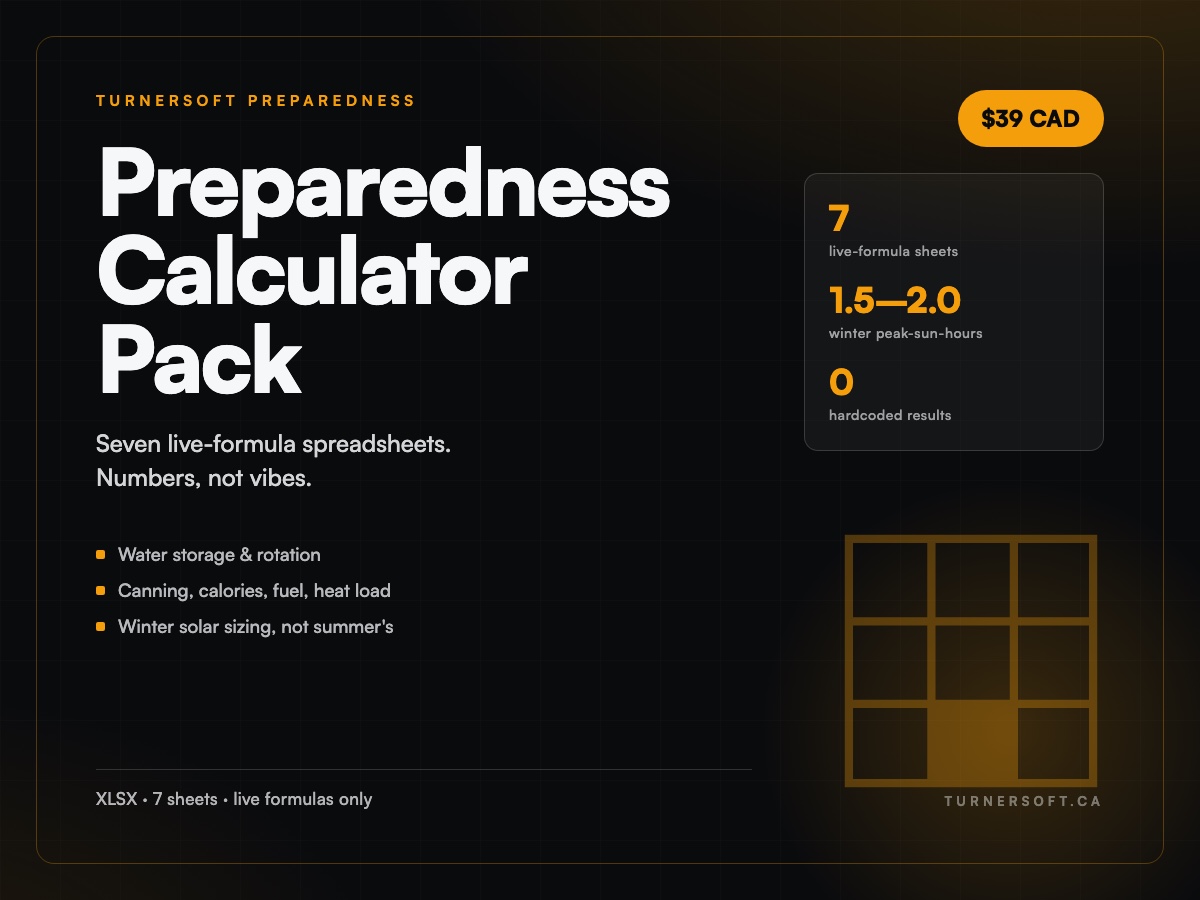
 Preparedness Calculator Pack · XLSX, 7 sheets, 298 live formulas · $39 CAD
Seven sheets that turn a worry into a number.
“I should get more water” is not a plan. 280 litres, fourteen 20 L containers, sixteen ordered, next rotation in six months is a plan. Every yellow cell is yours to edit; every green cell is a live formula, never a typed-in number.
What it is
A single .xlsx workbook of seven spreadsheets built the same way as the TurnerSoft fabrication calculators: real Excel formulas, yellow input cells, green outputs, dropdowns where a wrong guess would be dangerous, and the assumptions documented on the sheet they belong to. Excel, LibreOffice and Numbers all open it, and the formulas stay live in each one.
Nothing in it is a dead number. Change the household size, the days, the peak-sun-hours or the fuel price and every dependent figure moves with it — which is the point, because your household is not the worked example.
The seven sheets
Original, not relabelled. The workbook is written from first principles for a Canadian household — metric units, CAD prices, CSA and Health Canada references where a standard applies — and it reproduces no US federal framework. Nothing in it is copied from another seller’s spreadsheet.
| Sheet | What you put in | What it gives you |
|---|---|---|
| 1 · Water Storage | Household size, days, litres per person per day, allowance mode, container type, rotation interval and start date, container and filter prices | Total litres, the drinking and sanitation split, the 72-hour emergency minimum, mass on the floor, containers to buy with 10 % spare, purchase cost, the next rotation date and days until overdue, and a cartridge-versus-boiling cost comparison |
| 2 · Canning Planner | Product, jar size, batch size, altitude band | Jars needed, the water-bath-versus-pressure-canner decision, processing time by jar size and altitude, and canner loads — with the branch that fails closed |
| 3 · Calorie Storage | People, kcal per person per day, storage days, staple mix shares | Total kcal, kilograms per staple category, pails required, blended food cost, and a warning if the shares do not total 100 % |
| 4 · Winter Solar | Daily Wh load, appliance coincidence flags, system derate, season, peak-sun-hours, battery voltage, depth of discharge, cold derate | Array watts on your own hours, the same load sized on winter hours, the summer-sized comparison, the winter shortfall in plain numbers, panels needed, battery bank Wh and Ah, batteries required, generator hours to refill |
| 5 · Generator & Fuel | Generator rating, connected load, burn at 50 % load, no-load draw, fuel type, fuel stored | Load as a share of rating, fuel burn at your load, runtime on what you actually have stored, storage life and stabiliser interval, and cold-weather fuel notes |
| 6 · Heat & Wood | Floor area, insulation quality, indoor and outdoor design temperatures, stove efficiency and output, wood price | Heat-load coefficient, BTU/h and kW at your design temperature, cords per winter with a cold-winter buffer, stove output against load, and cost per heat source |
| 7 · Kit & Cost | Per-item quantities and prices, tax and shipping | A running total, the three tier subtotals, and the variance against your own target |
The canning planner fails closed
Pick a low-acid product and it prints PRESSURE CANNER REQUIRED and refuses to give you a boiling-water bath. That is not a preference setting: botulism toxin has no smell, no taste and no visible sign, so a boiling-water time for a low-acid food is not a shortcut, it is the failure. Any product the tested table does not recognise resolves to the conservative answer — low-acid, pressure canner, longest time, highest pressure — and the sheet says so in red.
The default workbook product is snap beans, which is low-acid, so the sheet shows you the refusal before you have entered anything. Process times are presented from the published USDA process tables with the Health Canada and provincial public-health cross-reference, and jar sizes are labelled in millilitres.
Winter numbers, not July numbers
The solar sheet is the one people need. An array bought for July is a broken promise in February, so the sizing runs on December’s 1.5–1.8 peak-sun-hours — what Ontario actually delivers in winter — instead of June’s 5.8. It shows the winter shortfall as a number rather than hiding it.
Two more decisions are deliberate. Coincidence, not arithmetic sums: the continuous-power check multiplies each appliance’s running watts by a 0–1 coincidence factor, because a fridge compressor, a furnace blower, a microwave and a water-treatment load do not run at once. And the well pump is excluded from the battery load entirely — it belongs on the generator sheet, the same doctrine the playbook states. Cold derates are kept separate from depth of discharge, because lead-acid loses a large share of usable capacity near −25 °C and LiFePO4 will not accept a charge below 0 °C at all.
What the sheets return at their shipped defaults
These are the figures read back out of the shipped workbook, so you can see what the defaults are before you replace them with your own:
| Sheet | Measured output as shipped |
|---|---|
| Water Storage | 280 L total — 224 L drinking and cooking plus 56 L sanitation; 70 L per person over the period; 48 L 72-hour emergency minimum; 14 containers needed, 16 ordered; a rotation date on the sheet |
| Canning Planner | Low-acid default → PRESSURE CANNER REQUIRED and a real processing time, never a five-minute placeholder |
| Calorie Storage | 30 days for four people → 102.5 kg of staples, 5 pails, about $461 blended |
| Winter Solar | Continuous-power check PASS on the entered load; the shortfall against a summer-sized array is shown, not assumed away |
| Generator & Fuel | Fuel burn at your load, runtime on stored fuel, and the storage-life and stabiliser interval |
| Heat & Wood | Coefficient 1.6 W/m²K → 240 W/K and 11,040 W; 6.3 cords burned, 7.3 ordered; $3,285 for the season |
| Kit & Cost | Tier 1 core $250 · life-safety set $212 · Tier 1 complete $462 · Tier 2 $750 · Tier 3 $2,500, with variance $0.00 at the defaults |
Prices in the workbook are Ontario retail estimates in CAD and every one of them is an input: replace them with what you were actually quoted. The workbook does not pretend to know your local price, and the variance row compares your build against your own target.
What it does not cover
It is not a design or engineering tool. It will not size a service, specify an interlock installation, or sign off on a generator connection. Those belong to a licensed electrician and the ESA permit.
It will not answer a canning question the tested table does not contain. That is the feature, not a gap: an unrecognised product returns the conservative low-acid answer instead of a plausible one.
It does not decide what to buy first. That is the audit’s job, and it is a different product.
It gives no medical dosing, no legal advice and no fuel-storage permission. Local rules on how much fuel you may store, and where, are yours to confirm.
It is not a weather model. Peak-sun-hours, design temperatures and burn rates are planning figures for a typical rural Ontario house, entered and editable by you.
Preparedness Calculator Pack — $39 CAD
One .xlsx workbook, 7 sheets, 298 live formulas. Instant download, one household, and the formulas stay live on your machine — nothing phones home and nothing expires.
The rest of the line
Winter Grid-Down Playbook — $27
The doctrine the spreadsheets assume: 43 pages in threat order, with the drills and the cost tiers in full.
Family Preparedness Audit — $15
Do the audit first and the calculators get a work order instead of a guess.
The Complete Preparedness Kit — $65
All three products, four files, $16 less than buying them separately ($81).